procedural things like thevenin theorem has a good reputation of being fairly easy to forget, when I was first tough it, they say it like: 1…, 2…, 3… .
this was kind of magic to me, why this thing even works and how mr thevenin got it, and every now and then I found that I should revise it.
so let me tell you how it is often tough:
- Thevenin theorem is only applied to linear circuits.
- some number of steps to apply the method.
even when they tough me it, they never mention that it is limited to linear circuits although it is a core propriety without it, it make absolutely no sense as will be mentioned later.
so with that being the problem let’s get to work, this is how I manged to understand it in a way that makes me say ‘now this is how the magic works’.
the keyword to thevenin theorem is superposition, as you will see thevenin is built on top of superposition theorem, superposition works only with linear circuits as it is a consequence of linearity, so the modified superposition (thevenin) won’t work with non-linear circuits also.
note, I assume you know what is superposition.
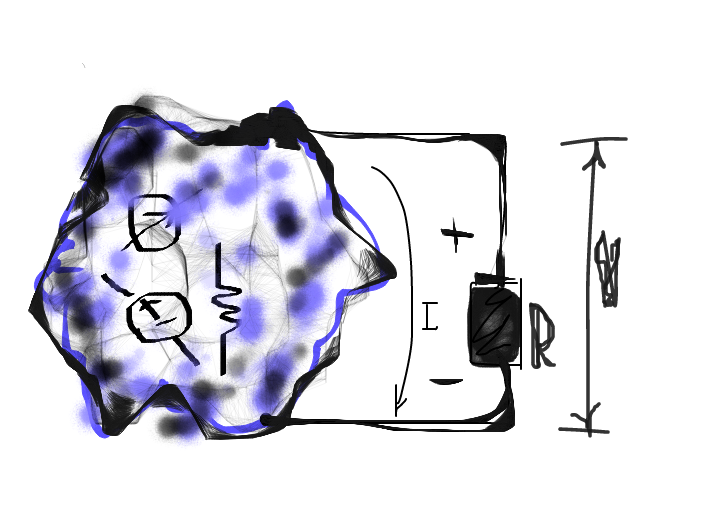
so we have a complex network of voltage sources, current sources and any possible element and we want to calculate v and i for a part, like the following figure.
I don’t know why it is ugly like that, but it does the job.
 |
| 😀 deal with it. |
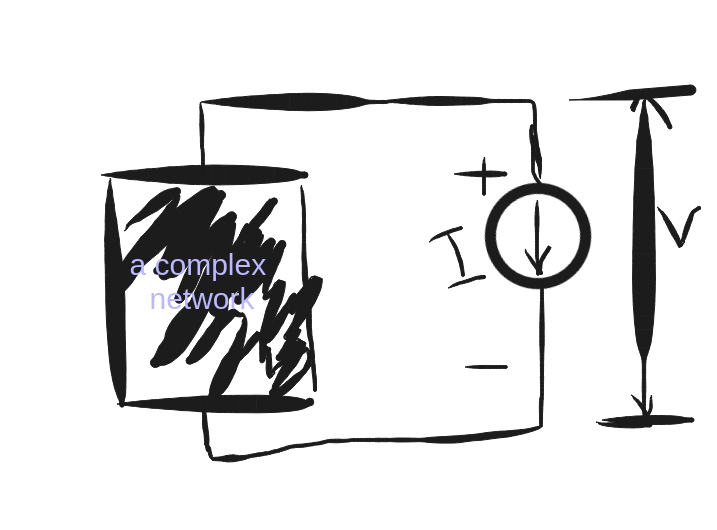
now the main trick, I will replace that resistor with some thing that has the same effect on the circuit, the remainder of the circuit has no problem with that, this replacement to ease things up.
now what is the effect of a load or a resistor on the circuit? , it loads ( lol 😀 ) the circuit by demanding certain amount of current, as you might know we deal with loads as current sinks.
so I will replace the resistor with an ideal independent current source that has same current as I on the resistor, and this current source will have a terminal volt of v as v on R, so basically no thing has changed from the point of view of the other part of the circuit.
now let’s start apply superposition to calculate v.
so we will calculate v due to every source in the complex network separately ( for every source we zero all other sources and calculate the corresponding v), so we will sum the volt v due to all sources but our fictional current source, we will call that sum”vx” , note we don’t add the effect of our current source on v yet, now what is that value vx we get?, it is the volt v due to all internal sources only, it is the same as measuring the volt v after removing the load, sometimes it is called the no load voltage, this will become very handy soon .
completing superposition , and as we know the current I due to the load will reduce the volt vx, as you might know when you load some output ( draw some current) you reduce the output volt, the volt v due to the current source only=is this unknown current I * the resistance of the network to this current after shorting all sources(R”).
so V=vx-I*R”.
this looks like a network in it vx is a voltage source and R” is a series resistance and we want t to calculate the volt on the remainder of the network.
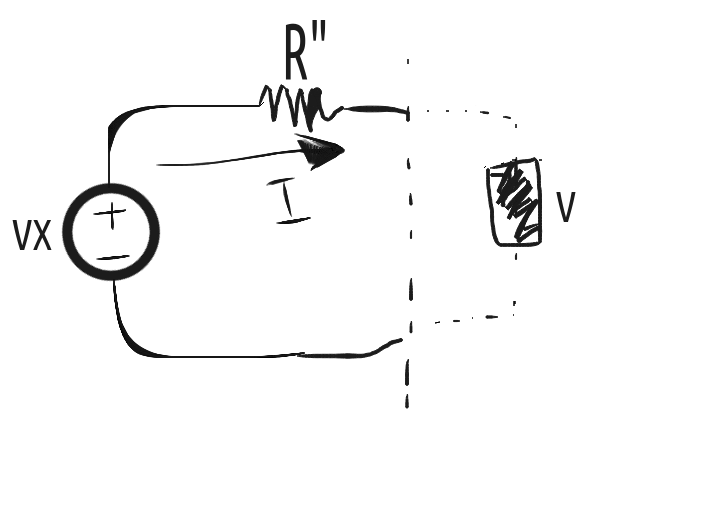
this is the end as we now have equivalent circuit (the figure above) and it is easy to calculate I and V from it, just basic things.
so all thevenin is about is to get this equivalent circuit, it calls vx ‘Vth’ ,R” ‘Rth’.
now look at any format of thevenin procedure and it is saying this implicitly, every time I deal with thevenin and it isn’t in my mind I just think about superposition and it comes by nature.
 Anas
Anas 
Leave a comment